2026-10-26
The screening programme that keeps the cure out
A gene therapy that can cure transfusion-dependent beta-thalassaemia is approved, yet in China, which has more of these patients than any other country, nobody has received it; a comparison of four countries argues that the institutions built to prevent the disease are what stand in the way. A new essay names the "digital incidentaloma", the abnormality a consumer wearable finds when nobody asked it a clinical question, and the chain of tests that can follow. At the European oncology congress, high-dose omega-3 given around liver surgery missed its primary endpoint while overall survival favoured it, and a second claudin-targeting drug conjugate extended survival in gastric cancer. A systematic review of ageing trials finds no study in which moving an epigenetic clock reliably went together with moving a clinical outcome. And in one of the first randomised trials of a language-model feature built into an electronic health record, clinicians felt less burdened but saved no time.
Connecting the dots
Payment rules decide which care survives. The thalassaemia paper names a "fiscal" lock-in: whoever paid for prevention is not set up to pay for a cure. In Korea, obstetricians say that raising the fee per delivery makes things worse for small units, because "only high-volume hospitals survive" (translated from Korean) (Korean Doctors' Weekly). An economist who backed the US Affordable Care Act now writes that the law barred its research institute "from conducting formal cost-effectiveness analyses" (STAT). In each case the way money is routed decides which service is still there ten years later. Today's journal titles include a payer trying the opposite design: "Taiwan's national NGS reimbursement model for a learning precision oncology system".
Two failures of the same loop: findings nobody asked for, and findings nobody follows up. One essay defines the digital incidentaloma, which can set off a chain of further tests. The UK patient-safety investigator documents the opposite failure: a significant finding is reported, and there is "very little assurance that the actions indicated by the findings have been taken" (HSSIB). Today's titles add a third case: "Remote Monitoring Failed to Predict Sudden Pacemaker Failure in a Recalled Device: A Case Report". Speculation: a monitoring programme has to be designed for all three at once, the false alarm, the dropped alarm and the alarm that never came.
Saying "I don't know" as a feature. A lab-robotics maintainer explains that many instruments have so few sensors that the software keeps track of their state on its own, and proposes adding an explicit unknown state for when the two disagree. A materials paper corrects its own earlier accuracy figure after finding that the choice of statistical unit drove it. A new community pipeline does nothing except write the audit trail. Three fields with no shared vocabulary, each making uncertainty something you can record. The titles carry the idea further: "How evaluation protocol choices inflate intrusion detection accuracy: A three-dataset systematic study".
New concepts
Prevention-era institutions that lock out the cure
"Yet in China, which carries the world's largest TDT patient population, no patient has received the therapy" … "This paper argues that prevention-era institutional architecture constrains cure-era access" — Huang, Social Science & Medicine, via PubMed
TDT is transfusion-dependent thalassaemia, the severe form of the inherited anaemia. The paper compares Cyprus, China, Thailand and India and proposes three lock-ins. The first is cognitive: genetic information flows towards carrier screening and reproductive choice, not towards treatment. The second is infrastructural: treatment capacity sits in the wrong places. The third is fiscal: who carries the cost. Across the four cases, "No pathway simultaneously optimizes all four readiness dimensions." The author presents this as a typology for generating hypotheses rather than a tested model, and proposes applying it to sickle cell disease and haemophilia.
Why it matters: countries with the strongest prevention programmes may have built the wrong structures for the gene and cell therapies now arriving, and the paper gives payers and ministries a way to name that before the next curative product reaches them.
The digital incidentaloma
The authors describe it as "an unsolicited or unexpected abnormality detected through consumer-facing digital surveillance" … "Unlike traditional incidental findings, digital incidentalomas arise from persistent interrogation of normal physiology" … "Their detection can initiate diagnostic cascades, increase healthcare utilization, contribute to patient anxiety" — Khanna, Sia, Wachter, American Journal of Medicine, via PubMed
An incidentaloma is the classic chance finding on a scan done for another reason. What is new here is persistence: a watch or ring measuring normal physiology all day will find variation, artefact and misclassification as well as disease. The authors add that the cost of chasing these findings shifts from the technology companies to health systems, and propose risk-based pathways plus confirmation of anything potentially actionable by established clinical methods. The essay gives no counts.
Why it matters: anyone designing continuous or multi-condition screening now has a name for the cost that grows with every hour of monitoring.
Basic biology
In the human cortex, resting energy use follows mitochondria, and stimulus-driven use does not
"mitochondrial distribution showed strong association with the intrinsic energy requirements at resting state" … stimulus-related relations were "driven by sensory input and mitochondria-sparse thin-axon neurons" — Murgas et al., bioRxiv
The authors relate regional glucose metabolism to cell composition and mitochondrial maps across the cortex. As a by-product they release "transcriptionally derived cytoarchitectonic maps of the human cortex that are consistent with histological findings", built from gene expression corrected for post-mortem sampling effects.
Why it matters: it separates two kinds of brain energy demand, the baseline cost tied to where mitochondria sit and the evoked cost carried by thin, mitochondria-poor axons. Studies that read glucose uptake as one signal may need to tell them apart.
One splicing factor holds the ovarian reserve, largely through one exon
"SRSF2 is required for maintaining the ovarian follicle reserve" … "Oocyte-specific ablation of Srsf2 using Gdf9-Cre causes complete female infertility" … "Supplementation with correctly spliced Nobox mRNA partially rescues" follicle development in vitro — Yue et al., Journal of Genetics and Genomics, via PubMed
In mice, deleting the splicing regulator SRSF2 only in oocytes causes exon 7 of the oocyte transcription factor Nobox to be skipped, lowering full-length NOBOX protein. The rescue is partial, and the authors say Nobox is not the only target.
Why it matters: it ties premature ovarian failure to a single mis-splicing event that can be partly corrected by supplying the right isoform.
Methods
An open floor that weighs each paw of a freely moving rat
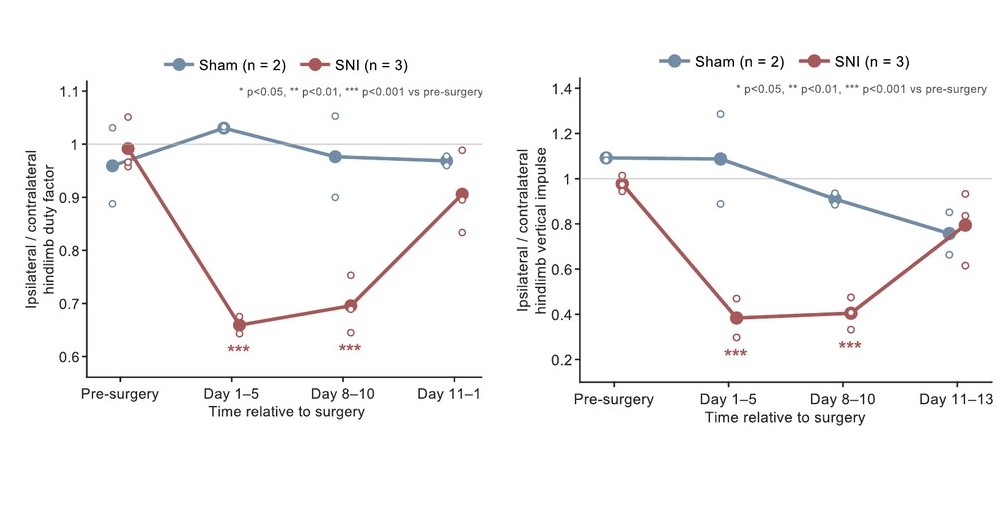
"the platform provides 16,384 tactile sensing elements at 2-mm pitch across a 512 x 128-mm runway" … "In a longitudinal rat model of sciatic nerve injury, the platform detected reduced loading of the injured hindlimb" — Lu et al., bioRxiv, CC BY
"Peak loading of the injured hindpaw decreased by 27%, and that of the contralateral hindpaw increased by 22–23%." … "Both ratios returned toward baseline by days 11–13." — authors' project site
The authors start from a gap: "most behavioral measurement systems primarily capture movement and posture", and force needs specialised equipment. Their modular runway costs "approximately US$550 in parts per runway", reads only the parts of the array where a paw is touching, and assigns contacts to individual paws, "correctly identifying 93.3% of 2,469 manually annotated contacts". The nerve-injury cohort is small. Code, circuit-board files and 85 labelled recordings are openly licensed.
Figure 5d, Lu et al., bioRxiv 2026, CC BY 4.0, link
Plantar pressure maps, Lu et al., bioRxiv 2026, CC BY 4.0, link
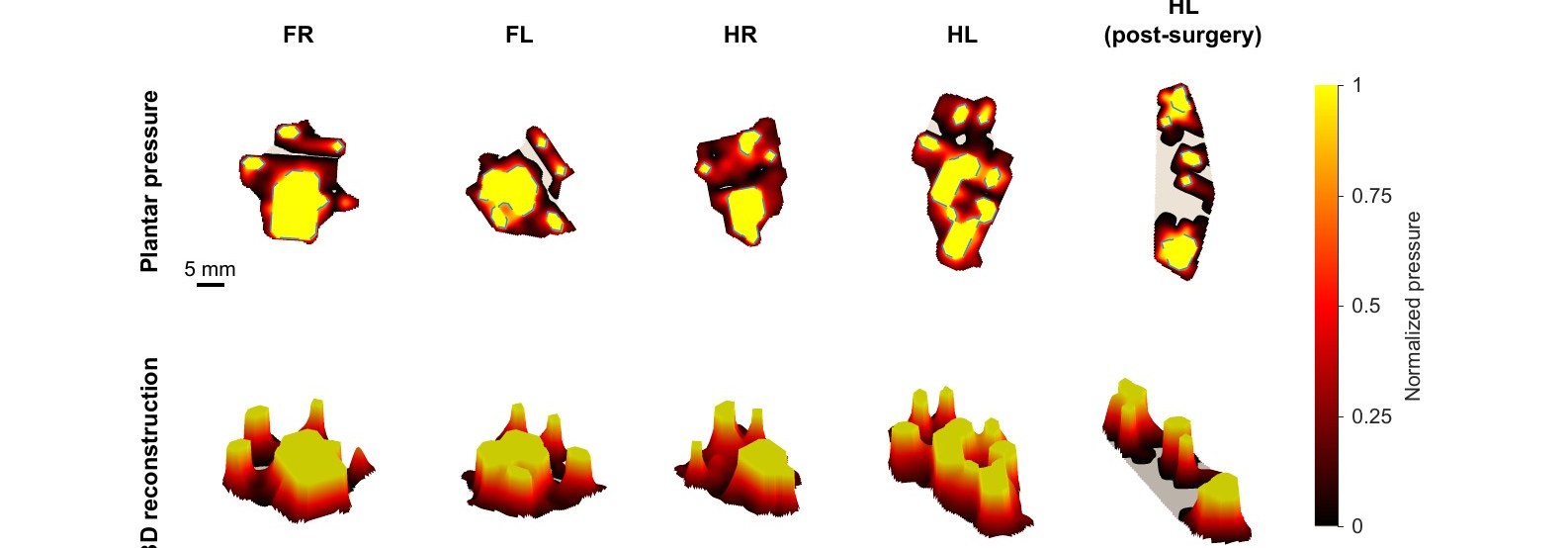
Why it matters: limb guarding is part of how animals express pain, and the authors report load changes that conventional gait timing underestimated. Pain and motor studies can get a per-paw force readout without specialised instruments. Today's titles ask the same question from the other side: "Redefining chronic pain models: What should we model?"
Clinical trials
Omega-3 around liver surgery: no effect on recurrence, a survival signal on a secondary endpoint
EMT2, an academic phase 3 in England and Wales, gave 418 patients with colorectal cancer spread to the liver either icosapent ethyl, a purified omega-3 fatty acid, or placebo, starting before resection. Progression-free survival did not differ (median 13.5 against 12.9 months, hazard ratio 0.89, not significant). Five-year overall survival was 62.0% against 45.1%, hazard ratio 0.68. The presenters' own caution: "The OS findings should be interpreted in the context of OS being a secondary endpoint and the negative primary endpoint." — OncoDaily
Why it matters: a cheap oral agent tested without industry sponsorship shows a survival difference that no change in recurrence explains. That is a reason for a confirmatory trial rather than for prescribing.
A second claudin-18.2 drug conjugate prolongs survival in gastric cancer
"the median OS was 10.0 months (95% CI, 7.2-11.4) with sonesitatug vedotin" against 5.0 months, "a 53% reduction in the risk of death" … "The other dual primary end point, progression-free survival (PFS), did not reach statistical significance." — OncLive
The patients had claudin-18.2-positive gastro-oesophageal cancer treated in the third line or later. An antibody-drug conjugate carries a toxic payload to cells expressing the target.
Other phase 3 results from the same sessions:
- In KRAS G12C lung cancer, divarasib against the two approved drugs of its class, head to head: "the median PFS per blinded independent central review (BICR) was 9.8 months (95% CI, 8.1-12.9) with divarasib", against 5.7 months (OncLive).
- In EGFR-mutant lung cancer after osimertinib, adding the MET inhibitor savolitinib beat chemotherapy on progression-free survival (7.6 against 5.4 months, hazard ratio 0.55), in patients whose MET status "had to be centrally confirmed on a postprogression tissue biopsy" (OncLive).
- In first-line biliary tract cancer, ivonescimab, a bispecific antibody against PD-1 and VEGF, plus chemotherapy against durvalumab plus chemotherapy: "the median OS was 14.9 months (95% CI, 12.9-not evaluable) in the ivonescimab arm (n = 340) vs 12.1 months" (OncLive).
A randomised trial of an AI chart summariser inside the health record
"284 outpatient clinicians across forty-two specialties" were randomised to a vendor's outpatient chart summarisation tool or usual care for 90 days; it "modestly reduced physician task load" and was associated with lower burnout, "without time savings and against declining engagement." — PubMed 42922608 (preprint, not peer reviewed)
Why it matters: a randomised test of a generative-AI feature as it is actually deployed, rather than a benchmark. The benefit was in how the work felt, and use fell over the three months.
Returning a genetic risk result without a clinician
"Disclosure of APOE genotype by the eSMARTER digital platform is non-inferior to clinician-mediated telehealth disclosure." — PubMed 42922812 (preprint)
APOE is the main common genetic risk factor for Alzheimer's disease. In 651 adults aged 60 to 80 across the US, fully digital disclosure matched telehealth with a clinician on knowledge, anxiety and distress one to seven days afterwards. Nothing longer-term was measured.
Two smaller results worth keeping
A simpler schedule for a standard later-line colorectal regimen held up in a 972-patient Japanese trial: "Median overall survival was 10·3 months (95% CI 9·5-11·6) in the 28-day group and 11·3 months" in the 14-day group, "stratified hazard ratio 0·93 [95% CI 0·80-1·08]" (Lancet, via PubMed). And blood-pressure titration by text message after hypertensive pregnancy, in 200 women in Boston: "The virtual intervention did not differ from routine care with respect to the primary outcome", measured in the clinic, while "home-reported SBPs during the same period were lower among those randomized to the intervention" (PubMed 42925856). Home and clinic readings disagree, and the trial's verdict depends on which one counts.
Hospitals
Korea: resistant gut-bacteria infections doubled in four years
"CRE infection reports rose every year from 23,310 in 2021 to 49,053 in 2025." … "Even after the programme began, CRE reports rose 15.8%" from 2024 to 2025. (translated from Korean; originals: "CRE 감염증 신고는 2021년 2만3,310건에서 매년 증가해 2025년 4만9,053건을 기록했다." and "하지만 사업 시행 이후에도 CRE 감염증 신고는 2024년 4만2,346건에서 2025년 4만9,053건으로 15.8% 증가했다.") — Korean Doctors' Weekly
CRE are carbapenem-resistant Enterobacterales, gut bacteria resistant to one of the last broad antibiotic classes. People aged 70 and over now account for about seven in ten reports. The disease agency plans to extend its antibiotic stewardship pilot to smaller hospitals, but "In Korea, a lack of dedicated staff and infrastructure limits how far institutions run ASP voluntarily." (translated from Korean; original: "국내에서는 전담 인력과 인프라 부족으로 의료기관이 자발적으로 ASP를 운영하는 데 한계가 있다.") (Korean Doctors' Weekly). For now the pilot covers only hospitals with more than 300 beds.
Why it matters: the rise continued after the stewardship programme started, and the hospitals left out of the pilot are the ones without the staff to run stewardship themselves.
Korea: a third of delivery units closed in ten years
"Facilities able to deliver babies fell by 230 (34.1%) in ten years, from 675 in 2014 to 445 in 2024." (translated from Korean; original: "전국 분만 가능 의료기관은 지난 2014년 675곳에서 2024년 445곳으로 10년간 230곳(34.1%) 감소했다.") — Korean Doctors' Weekly
Almost a third of the country's 250 districts have no delivery facility left, and another quarter have one. The obstetric society asks for support for fixed costs, since a delivery ward must be staffed at a cost the hospital carries "whether it delivers or not" (translated from Korean; original: "분만을 하든 안 하든 병원에서 유지해야 하는 비용").
Why it matters: a fee paid per delivery cannot keep a unit open where there are few births, and the proposal is to fund the standby instead.
The finding was reported, and nobody acted on it
"There is very little assurance that the actions indicated by the findings have been taken." … "Opening a report and generating a read receipt is an unreliable form of acknowledgement." … "There is no nationally agreed list of what constitutes an unexpected significant finding that should trigger an alert." — HSSIB, 2019
The reference case was a chest X-ray showing a possible lung cancer that "was not followed up". The investigator asked for "a monitored acknowledgement system for critical, urgent and unexpected significant findings." A companion investigation started from "a patient was discharged from hospital on two separate occasions with a plan to follow-up in outpatient clinics", and neither appointment was booked; it asked for "standards and an operating framework" with automated checks, so that there is "less reliance on staff vigilance" (HSSIB, 2021).
Why it matters: both failures sit between systems, in the step where nobody owns the next action, which is what a monitored acknowledgement is meant to close.
Medicine concept of the day
"CRE" is a family of enzymes, and the enzyme picks the drug
US guidance defines CRE as Enterobacterales resistant to at least one carbapenem or producing a carbapenemase, an enzyme that destroys these antibiotics. "Carbapenemase-producing isolates account for 35%-83% of CRE cases in the United States", and the enzymes differ in chemistry: "KPC and OXA-48-like enzymes are serine carbapenemases", while NDM is a metallo-enzyme, and "neither avibactam, relebactam, nor vaborbactam inhibit NDM" (IDSA). The treatment therefore splits by enzyme family:
- "Ceftazidime-avibactam, imipenem-relebactam, and meropenem-vaborbactam are preferred treatment options for KPC-E infections."
- "Aztreonam-avibactam and cefiderocol are preferred treatment options for NDM-E infections."
- "Ceftazidime-avibactam is the preferred treatment option for OXA-48-E infections.", because "Unlike avibactam, both vaborbactam and relebactam demonstrate limited inhibitory activity against OXA-48-like enzymes."
Laboratories detect these two ways. Phenotypic tests show that some carbapenemase is present; gene tests name it, as in "PCR positive (for KPC, NDM, OXA-48, IMP, or VIM)" (CDC case definition). The best evidence that naming it helps is observational, from eight centres in New York and New Jersey where KPC is endemic. Patients whose blood cultures went through PCR "had shorter time until receipt of active therapy (median: 24 vs 50 hours; P = .009)", and "blaKPC PCR testing was associated with decreased 30-day mortality (adjusted odds ratio: .37; 95% CI: .16-.84)" (Satlin et al., Clinical Infectious Diseases 2022).
The limits are as instructive. Which enzyme dominates is a local fact: in a year of Seoul surveillance "853 (58.1%) isolates were tested positive for at least one CPE" and "KPC (K. pneumoniae carbapenemase)-2 was the most common CPE type (46.0%)" (J Bacteriol Virol 2020), which leaves a large minority of Korean CRE with no carbapenemase at all. The first-choice drug can also fail mid-course: "Resistance emergence during ceftazidime-avibactam therapy has been reported in approximately 10% of cases" (IDSA), and the PCR still reports KPC when it does. Some isolates are "Positive for phenotypic carbapenemase production (e.g., mCIM, CIM, CarbaNP) but negative by polymerase chain reaction (PCR)" (CDC): enzymes the standard panels miss.
Still unknown: whether routine enzyme typing lowers mortality where KPC is not the dominant enzyme. No randomised trial has tested testing.
Worth knowing
Moving an epigenetic clock does not reliably move outcomes. A systematic review of ageing-intervention trials included "Twenty-six independent studies", and "no comparative study or study of patient-important outcomes was uniformly concordant." Also: "Certainty was very low across all assessed evidence bodies." The authors conclude that "Epigenetic clocks should currently be considered exploratory or adjunctive biomarkers of intervention response" rather than validated surrogate endpoints (Yi et al., Experimental Gerontology, via PubMed). Any trial using a clock as its endpoint now has a reference that says what that endpoint is worth.
The statistical unit decides the result, and the authors correct themselves in the abstract. On 41 microscopy images, cross-validation by image "never falls below 75%"; grouped by specimen, the same pipeline gives "pooled out-of-fold accuracy of 56.6%" against a majority-class baseline of 53.7%, and "81% of out-of-fold predictions carry confidence above 0.9 while being correct only 58% of the time." They trace "a previously reported result from this work" to "a training-accuracy checkpoint-selection step rather than by data scarcity", and scope the finding: "This is a case study of one small corpus and does not establish general dataset-size thresholds" (Nair et al., Materials Today Communications, via OpenAlex).
Health systems and policy
An economist who backed the US health reform: "The curve did not bend"
"The curve did not bend, and I now wish I hadn't signed my name to that letter." … "But the big mistake, ironically, was the ACA's lack of focus on affordability." — Dana Goldman, STAT
Goldman was one of eleven economists who urged Congress to pass the Affordable Care Act in 2009. He notes that the law "prohibited the institute from conducting formal cost-effectiveness analyses" at the research body it created, and proposes an independent health-technology-assessment institute "set up without regulatory authority", which could not set prices but would aim to "discourage the 30% of care that does no good without heavy-handed government interventions."
Why it matters: an insider's account of why a reform that expanded coverage without comparing cost against benefit left spending where it was.
US overdose deaths nearly halved, and nobody measured why
"deaths peaked at 81,806 in 2022 and fell by almost half, to 44,564, in 2025" … "So far, the most plausible driver of recent declines in overdose deaths is a change in the illicit drug supply." … "One big gap is that we don't know with certainty what the supply shock was or what caused it." — Donahoe, Zhu, Barnett, STAT
The three authors rule out the expansion of naloxone and of treatment on timing. Their self-diagnosis: "We have been largely limiting our research focus to areas with data." They propose a survey reaching shelters and jails that records what people use and pay and tests drug samples, which "would tell us whether and how supply is changing, and how it affects drug use and risk".
Why it matters: one of the largest recent improvements in US mortality cannot be repeated or protected, because what caused it sits where nobody collects data.
Patents
A blood-testing patent holder with no public evidence and a departed inventor. Of Haemanthus, which holds a recent US grant on coherent Raman spectroscopy: "What it doesn't have, at least publicly, is a product customers can buy or published data showing its technology works." "It has also lost its chief technology officer.", a named inventor on its earlier Raman grant, and "Haemanthus plans to start with veterinary testing before pursuing human applications." (Fortune). A granted claim describes an instrument; it does not show that one works.
Startups and deals
An AI stethoscope priced like an ordinary one. Eko announced "FDA 510(k) clearance of the device for use in pediatric and adult patients", with "FDA-cleared AI for structural murmur detection", "Priced in line with premium traditional stethoscopes", rolling out to Canada, the United Kingdom and selected European markets (Eko Health). A 510(k) clears a device as equivalent to one already on the market. The release gives no sensitivity or specificity, and the AI is a yearly subscription on top of the hardware.
In-body CAR-T cells designed with generative models. A Shanghai company closed a Pre-A round in the hundred-million-renminbi range: "AI赋能体内CAR-T!锋寻生物完成亿元Pre-A轮融资" (translated from Chinese: "AI-powered in vivo CAR-T: DeliNova closes an RMB 100M-level Pre-A round") (VCBeat). It designs envelope proteins and nanobodies for vectors meant to engineer T cells inside the patient, removing the cell-manufacturing step that makes CAR-T a hospital procedure.
Repos and tools
A life-science agent kit. "This plugin consolidates 11 MCP server integrations and 5 analysis skills into a single package for life science researchers.", with connectors for literature, preprints, trial registries, drug targets and lab platforms; the skills are Apache 2.0 (GitHub).
Splitting a bulk difference into composition and state. cade sets out to "Separate an observed bulk transcriptomic difference into what a change in cell-type composition would produce" and what changed inside the cells, and tells its users where the limit is: "The residual is a bookkeeping identity, not a causal claim." (GitHub, MIT).
A pipeline whose only product is the audit trail. "nf-core/provenancereport is a reporting pipeline that validates a samplesheet and renders reproducible Quarto reports.", with checksums, software versions and provenance records in two standard formats (nf-core).
AI: using it well
The old specialist still wins on images. A consultant dermatologist tested 200 biopsy-proven skin lesions against two current general-purpose language models: "A ten-year-old network, fine-tuned for about twenty minutes, beat both of them at recognising skin cancer." The small convolutional network got 125 first-choice diagnoses right, the two language models 84 and 85. He lists the caveats himself: a small sample with only thirty melanomas, lesions harder than usual because all were biopsied, and the possibility that the language models saw the public dataset in training (Magnus Lynch).
Why it matters: for a narrow image task with good labelled data, the useful design may be a generalist that knows when to call a specialist model, rather than a generalist that answers itself.
Other frontiers
Transistors written into a single atomic layer
"By selectively changing parts of the top layer into tungsten oxide (WOx) as an insulator" … "without the normally requisite grafting on of different materials" … the researchers "create functional MOSFETs" — Hackaday
Regions of one tungsten ditelluride monolayer were converted chemically into an insulator and into n-type and p-type semiconductors, so the whole device sits in a single crystal layer with no stacking or transfer steps.
Why it matters: a route to atomically thin circuits, sensor read-out electronics among them, that avoids the transfer steps where layered devices usually fail.
Corners of the web
A robot that should be able to say it does not know. On the open lab-robotics forum, a contributor asks whether the framework needs a generic way to represent an unresolved physical state, since "Rolling the tracker back makes sense transactionally, but it doesn't mean the physical action didn't happen." The maintainer agrees on the difficulty: "syncing the state between hardware and software is one of the most important (and difficult) parts of PLR.", and notes that simple machines have few accessible sensors, so state is tracked on the software side (PyLabRobot forum). Nothing was decided. A separate thread raises the barrier to regulated use: a compliance specialist told one poster that "the lab seeking validation will have to "own" the entire codebase due to the open source nature" (PyLabRobot forum).
Someone rebuilds published open lab hardware and logs every gap. A member of the open-science-hardware community is assembling a motion toolchanger from a kit, to see "what we can learn about reproducing this system as we go." The log so far: about a hundred missing set screws, inserts packed in another box, one screw length wrong in the instructions, and the remark that "An inventory of what's in the kit would have been helpful." (GOSH forum). Published open hardware is rarely rebuilt by strangers, and this is what the second build costs.
People and good examples
Claude Cohen-Tannoudji, 1933–2026
The French physicist who shared the 1997 Nobel Prize for laser cooling died on 22 October at 93, his family told AFP (20 Minutes/AFP). The arc of the work, in his professional society's biography:
"This work led to an understanding of the optical effect known as light shift or the optical Stark shift." … a later series of experiments "allowed the researchers to demonstrate a new cooling scheme with no lower limit" … "These developments opened the microKelvin and even the nanoKelvin range to laser cooling." — Optica
Why it matters: one laboratory went from asking how light shifts an atom's energy levels to cooling schemes with no floor, which is where cold-atom physics and today's atomic clocks come from. He also wrote the quantum mechanics textbook that generations of physicists learned from, and his students include two later Nobel laureates.
Rural libraries that stay open with nobody inside
Members swipe a card for after-hours access after a short in-person briefing. At one Minnesota system, "renovating the Wyoming library to allow after-hours access cost about $70,000", and "It costs ECRL about $12,000 annually for the technology needed for extended access to work". At a twelve-branch Washington system, "From September 2023 to August 2026, more than 63,000 people swiped their library cards when the libraries were unstaffed." The worry was safety: "But so far, they say they haven't encountered any problems." And on jobs, the director says "Staffed hours remain as they were prior to implementation, and we expect that to continue" (Reasons to be Cheerful).
Why it matters: a public building serves more hours for a one-off renovation and a small annual software bill, in a system that had been cutting hours for lack of money. The article does not say how many distinct people used it.
Reads and ideas
The ingredients are catalogued and nobody can cook. Asking why decades of counting what cells contain have not let anyone build one, the founding editor of Asimov Press writes: "A list of ingredients is not a recipe, and a recipe does not imply mastery of cooking." His suspicion is that "we haven't yet mastered the fault tolerance or exquisite regulation required to do so." His proposal: "Instead of trying to build "a" cell, then, we ought to build many variants" and let selection pick, since "Molecules may be necessary to explain life, but they're also just one small part of the recipe." (Asimov Press)
Book of the day
Arrowsmith — Sinclair Lewis with Paul de Kruif (1925)
A doctor-researcher takes a bacteriophage that kills plague bacteria to a Caribbean island in an epidemic. His mentor sets the condition: "If I could trust you, Martin, to use the phage with only half your patients and keep the others as controls" (Project Gutenberg). He also has to defend the controls against officials who want every remedy given at once, because then "they could never tell whether the cures were due to Yersin or Haffkine or phage or none of them". The temptation, in the book's own words, is "to give up the possible saving of millions for the immediate saving of thousands". After his wife dies of plague he gives the phage to everyone, and the experiment is lost.
A historian of clinical trials credits the novel's reach: "It also popularized the idea of controlled clinical experimentation, while depicting it as a dramatic endeavour." She also argues the dilemma is partly manufactured, since the hero is offered phage or nothing: "A comparison of several treatments would not provide the novel with the same level of emotional charge". The real phage trials of the period failed the same way, where "the results were seen as inconclusive because the distribution of the phage was not strictly limited to experimental areas" (Löwy, James Lind Library, CC BY 4.0).
Why it matters: the either-or that destroys Martin has since been designed away. Ring vaccination trials against Ebola gave every cluster the vaccine and randomised only the timing, so a rollout produced evidence instead of a press release. The novel is where that problem first reached a wide readership.